
Preface
If you traded altcoins in 2014, you’ve probably heard of Mintpal. This UK exchange was once one of the hottest altcoin trading platforms — and then, within months, it suffered two “hacks,” had a CEO with a fake identity, an embezzlement and escape, an arrest and imprisonment (for rape, no less), and was eventually forced into liquidation.
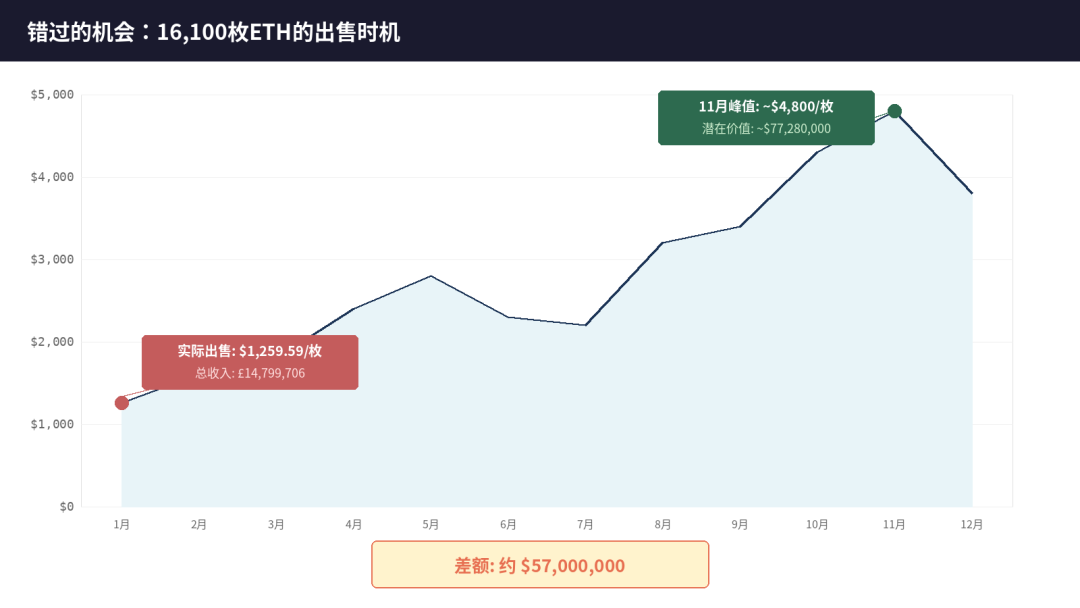
Even more surreal: that liquidation has lasted from 2015 to today — a full ten years. The liquidators spent four years battling the UK Crown Prosecution Service over frozen assets, another year in court to have those assets awarded to creditors, and then sold 16,100 ETH in early 2021 at $1,259 apiece — just half a year before ETH soared to $4,800.
I reviewed all eight official documents submitted to the UK Companies House for this case and compiled this comprehensive report.
I. The Story Unfolds
February 2014: Mintpal launched, focusing on altcoin trading with a fee of just 0.15%, quickly gaining popularity.
July 2014: It was hacked for the first time, losing 8 million Vericoin (around $2 million). The Vericoin team had to perform a blockchain hard fork rollback — an extremely rare move at the time — to recover the losses.
Summer 2014: A man calling himself “Alex Green,” through his company Moolah (i.e. Moopay Ltd), acquired Mintpal. He claimed to be a former Citibank employee, was famous in the Dogecoin community for lavish tipping, and had even sponsored a NASCAR car. The community trusted him completely.
October 2014: Mintpal relaunched under Green’s leadership. Soon after, 3,700+ BTC vanished (about $1.5 million at the time). Community investigators discovered the BTC was being sold on LocalBitcoins by an account called “LemonadeDev” — which was traced back to Green.
Dogecoin founder Jackson Palmer exposed him: Alex Green’s real name was Ryan Kennedy, a serial crypto scammer. Kennedy declared Moolah bankrupt and disappeared.
February 2015: Kennedy was arrested. He was later convicted on three counts of rape and sentenced to 11 years in prison.
II. A Decade of Liquidation
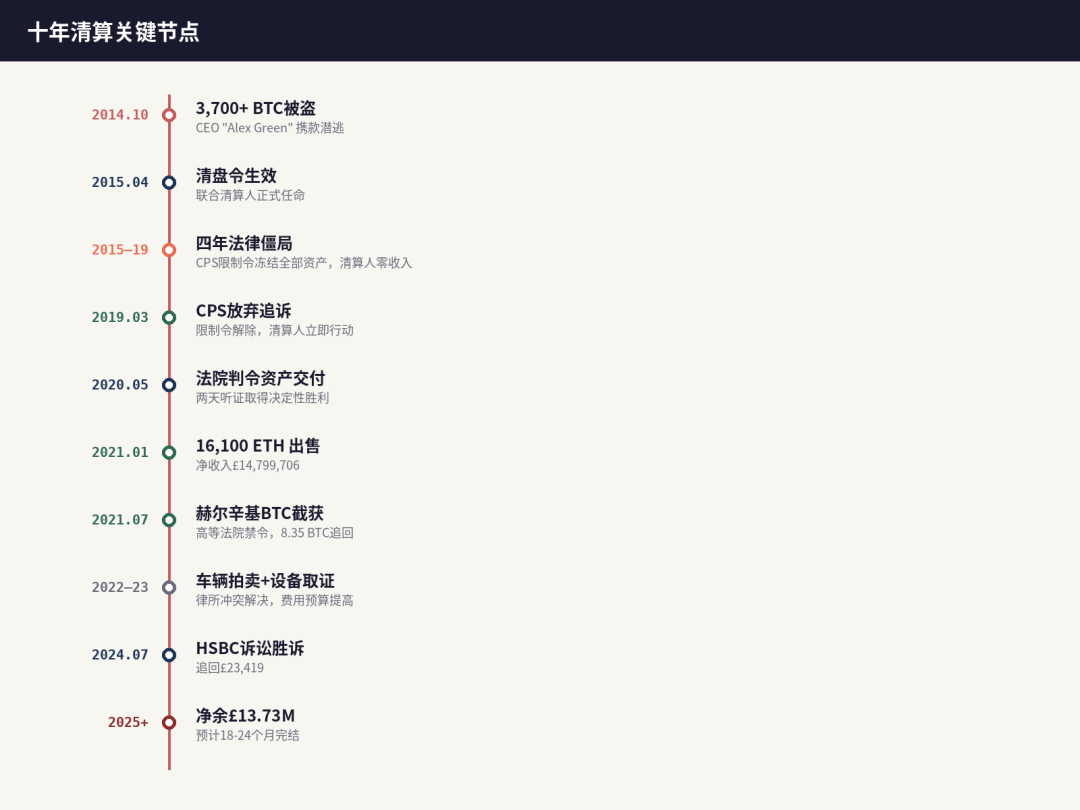
Phase 1: Legal Deadlock (2015–2019)
On April 27, 2015, the court issued a winding-up order. Liquidators Liam Short and Graham Wolloff were formally appointed.
But here came the problem: the UK Crown Prosecution Service (CPS), under the Proceeds of Crime Act, obtained a restraint order freezing all assets under Kennedy’s name — including crypto, bank accounts, vehicles, and electronic devices. The liquidators argued these belonged to the company and should go to creditors; the CPS insisted they were Kennedy’s personal criminal proceeds.
What followed was a suffocating four-year tug-of-war:
- July 2017: Liquidators applied to vary the restraint order; CPS lawyers requested a recess before the hearing to negotiate.
- September 2018: Liquidators reapplied; CPS again requested a recess.
- March 2019: CPS suddenly announced it would drop its case, and the restraint order was lifted.
Throughout these four years, the liquidators earned zero income, working entirely “at risk.”
Phase 2: Dramatic Turn (2019–2021)
Once the restraint order was lifted, the liquidators moved quickly:
- May 2019: Applied to the court for asset handover
- 2019–2020: Engaged in multiple legal rounds with Kennedy from prison (seven witness statements were filed in total)
- May 2020: The court ruled that the assets be delivered to the liquidators ✓
Then came the astonishing liquidation:
| Asset | Quantity | Unit Price | Proceeds |
|---|---|---|---|
| ETH | 16,100 | $1,259.59 | £14,799,706 |
| ETC | 16,100 | $10.20 | £115,506 |
| BTC | 8.35 | $65,931.81 | £392,175 |
The 16,100 ETH were sold on January 28, 2021, at $1,259 apiece. Six months later, ETH soared to $4,800 — had they waited, the value would have been $77 million instead of $20.3 million.
The BTC story was even wilder: in July 2021, police informed the liquidators that 8.35 BTC linked to Kennedy were about to be released by an exchange in Helsinki. The liquidators quickly filed for a High Court injunction to stop the transfer — successfully intercepting and liquidating the coins.
Phase 3: Wrapping Up & Distribution (2022–Present)
Since 2022, the focus has shifted to:
- Recovering funds from HSBC — the bank held £24,999 for years without paying out; the liquidators sued and recovered £23,419
- Digital forensics — many seized devices remain inaccessible due to BitLocker encryption
- Vehicle auctions — Jaguar XF sold for £6,853; Fiat 500 for £2,000
- Preparing formal claims against Kennedy’s bankruptcy estate
- Determining asset ownership between Mintpal, Moopay, and Kennedy personally
III. The Ledger at a Glance
As of April 2025:
| Item | Amount |
|---|---|
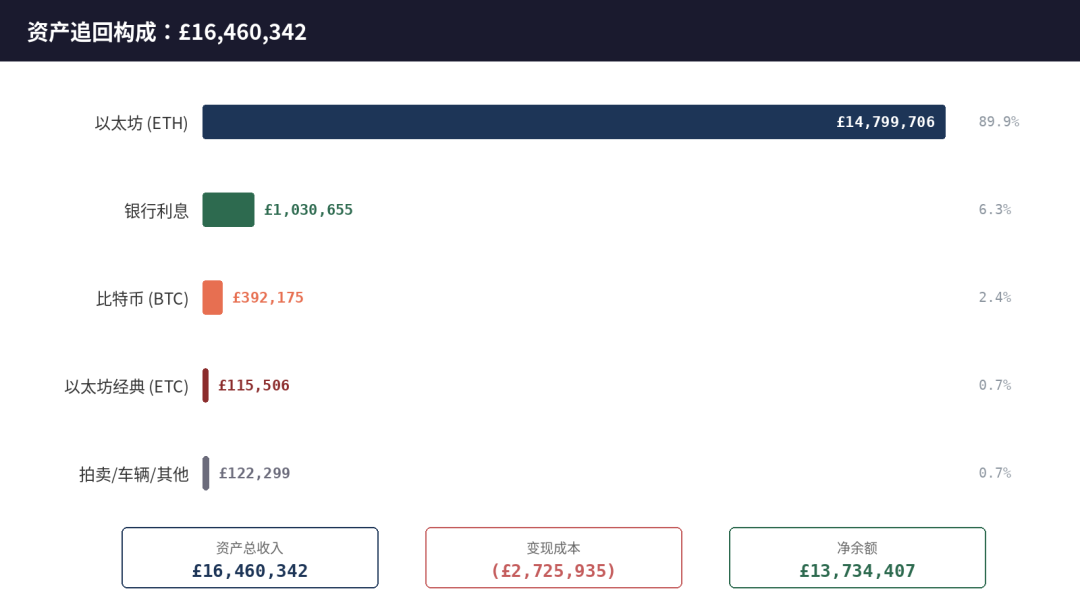
| Total Asset Income | £16,460,342 |
| Of which: crypto sales | £15,307,388 |
| Of which: bank interest | £1,030,655 |
| Of which: others (auctions, vehicles, etc.) | £122,299 |
| Total Realization Costs | (£2,725,935) |
| Of which: legal fees | (£595,000) |
| Of which: liquidator fees | (£1,216,369) |
| Net Balance | £13,734,407 |
All funds are currently held in an interest-bearing Insolvency Service Account.
IV. The Liquidator Fee Dispute
The liquidators bill by time, with a 100% uplift allowance:
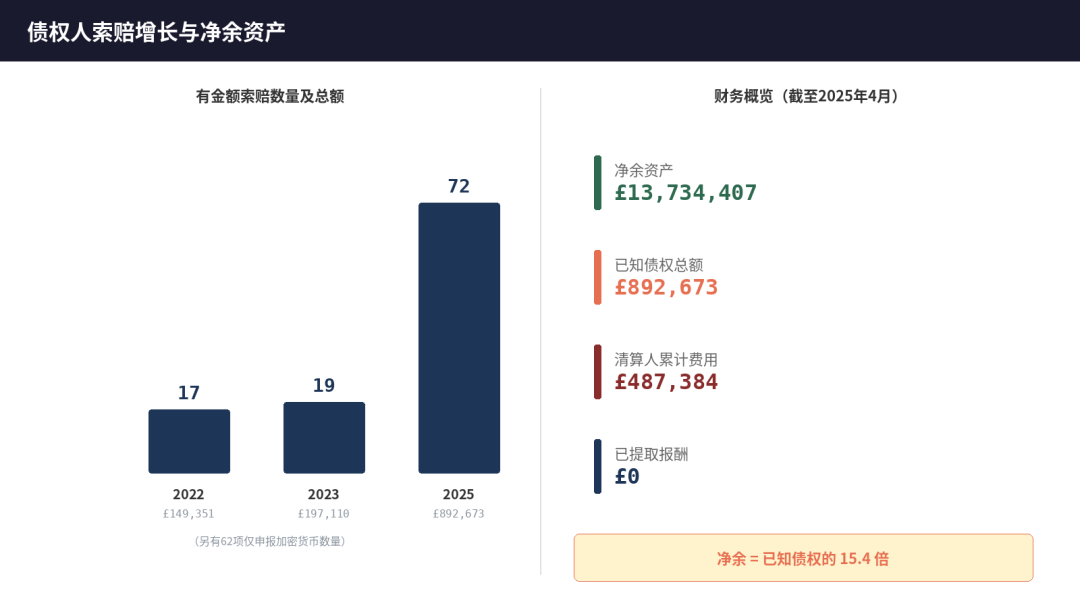
- As of April 2025: 1,357 hours, £487,384 (pre-uplift)
- The budget increased from £57,288 initially to **£700,147** (or £1,400,293 after uplift)
- No actual remuneration has been drawn yet — all “at risk.”
Partner hourly rates: £565–569; managers £443; administrators £295.
V. The Creditors’ Situation
| Year | Claims with Stated Amounts | Total Amount |
|---|---|---|
| 2022 | 17 | £149,351 |
| 2023 | 19 | £197,110 |
| 2025 | 72 | £892,673 |
Another 62 creditors reported the number of crypto assets lost but didn’t convert them to GBP. The total is expected to rise further. Currently, only 134 creditors have filed — a remarkably small number compared to the 14,000 victims.
VI. How Much Can Victims Actually Recover?
This is the question every Mintpal victim cares most about. Based on the eight official filings, let’s build as rigorous an estimate as possible.
A Legal Mechanism Extremely Favorable to Creditors
Under UK Insolvency Rules 2016 (IR 2016) Rule 14.21, claims denominated in “foreign currency” must be converted to GBP using the exchange rate on the start date of insolvency proceedings. For Mintpal, that date is April 27, 2015.
What does this mean?
On April 27, 2015, BTC was around **$236** (about £158). Ethereum (ETH) did not yet exist (it launched in July 2015).
So if a user lost 10 BTC on Mintpal:
- At 2015 valuation: 10 × £158 = £1,580
- At 2025 market price: 10 × ~£55,000 = £550,000
The liquidation uses the former. In other words, all crypto claims are legally valued far below their current worth.
Estimated Total Claims
| Category | Estimated Amount |
|---|---|
| 72 quantified claims | £892,673 |
| 62 crypto-denominated claims (2015 valuation) | ~£300,000–600,000 |
| Unfiled creditors | ~£100,000–200,000 |
| Estimated Total Claims | ~£1,300,000–1,700,000 |
Note: even if all 3,700 stolen BTC were valued at 2015 prices, that would only be about £585,000. The actual claims may be lower, since not all victims will file.
Distributable Amount: Three Scenarios
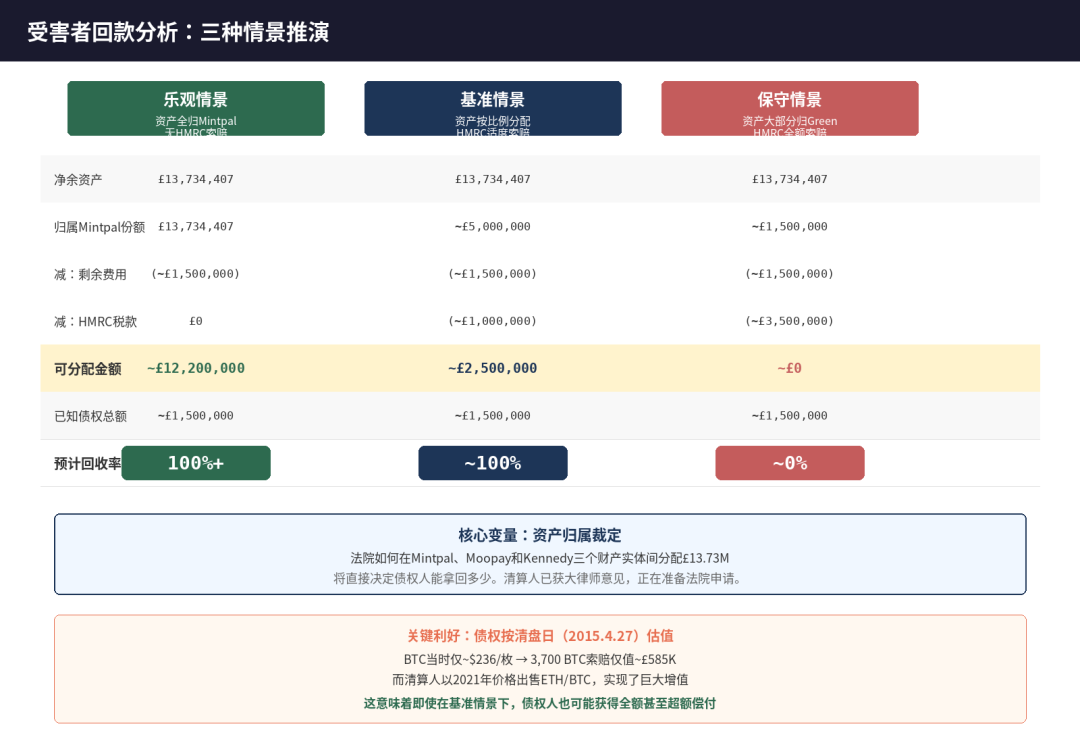
The key variable is asset ownership — the court must decide how the £13.73M is split among Mintpal, Moopay, and Kennedy’s bankruptcy estate.
Scenario 1 (Optimistic): The court rules most assets belong to Mintpal
The liquidators argue that the stolen funds originated from Mintpal user deposits and should thus belong to Mintpal’s estate. If the court agrees:
- Distributable amount: ~£12,200,000 (after remaining fees)
- Total claims: ~£1,500,000
- Recovery rate: 100%, with substantial surplus
Scenario 2 (Baseline): Assets are split proportionally among the three estates
Given Moopay and Kennedy also have creditors, the court may divide assets proportionally:
- Mintpal may receive £3M–5M
- After fees and potential HMRC tax: ~£1.5M–2.5M
- Recovery rate: close to 100%
Scenario 3 (Conservative): ETH assets mainly go to Kennedy’s estate
If the court rules that most assets (especially the ETH, held in wallets under Kennedy’s control) are personal assets:
- Mintpal’s accessible amount drops sharply
- But Mintpal may still file a preferential claim against his bankruptcy estate
- Recovery rate: depends on ranking within the estate, possibly 50%–100%
HMRC Tax Risk
A yet-to-detonate “time bomb” is capital gains tax. The liquidators sold crypto worth £15.3M that was acquired at nearly zero cost — in theory, HMRC could tax the gain. At a 25% corporate rate, that’s a potential £3.8M liability.
The good news: HMRC has made no claim (after ten years), and insolvency taxation has special provisions. But if HMRC does act, it could significantly reduce distributable funds.